Thank you for writing to us. One of our executive will reach back to you through your submitted medium. In case there’s an urgency, feel free to connect over WhatsApp for faster response.
Prefer calling? Dial +9108048043738 (International callers) or 08048043738 (Indian callers).
LS190 Gloss Meter – Overview
The LS190 is a handheld, cost-effective gloss meter designed for surface gloss measurement on materials such as paint, coatings, plastics, paper, ceramics, stone, metals, etc. It focuses on easy operation, reliable data, and quick quality control with support for batch testing.
📊 Technical Parameters
Parameter Specification
Measuring angle 60° (standard medium-gloss geometry)
Measuring spot / aperture 9 mm × 15 mm
Minimum sample size 20 mm × 10 mm
Measuring range 0–200 GU (Gloss Units)
Resolution 1 GU
Repeatability ±1 GU (0–120 GU); ±1 % (120–200 GU)
Reproducibility ±1 GU / ±1 %
Zero error 1 GU
Indication error ±3 GU across range
Power supply Rechargeable lithium battery (3.7 V, ~600 mAh)
Display 240×128 dot matrix LCD
Languages English & Simplified Chinese
Data communication USB-C to PC
Dimensions ~140 × 48 × 75 mm
Weight ~237 g
Operating temp & humidity 10–45 °C, 0–85 % RH (no condensation)
Storage temp −10–60 °C
Gloss Units (GU) are the standard measurement unit for specular reflection and surface shine.
✨ Key Features
✔ Easy to Use
The meter can be put on the surface and measured immediately with no button press required in basic mode.
✔ Normal & QC Mode
Normal Mode for single measurements.
QC Mode allows setting upper & lower limits for automatic qualification results — ideal for batch inspections/quality control.
✔ Accurate & Stable
Uses D65 light source and photopic spectral response to improve accuracy on colored samples.
High repeatability/resolution for consistent results.
✔ Robust Design
Passes extensive quality tests (thousands of calibration, stability, vibration and aging tests) to ensure reliability.
✔ Ergonomic & Portable
Lightweight ergonomics with a comfortable grip.
✔ Long Battery Life
Auto-shutdown and efficient power use for extended measurement sessions.
📜 Standards & Compliance
The LS190 conforms to major national and international gloss measurement standards, ensuring its measurements are consistent with industry practice:
International Standards
ISO 2813 – Surface gloss measurement for paints/coatings.
ISO 7668, ASTM D523, ASTM D2457 – Standard methods for specular gloss testing.
DIN 67530 – German gloss measurement standard.
Chinese Standards
GB/T 9754, GB/T 13891, GB/T 7706, GB/T 8807 – National gloss/testing standards.
Meets Grade 2 working machine performance according to JJG 696-2015 verification regulation for gloss meters.
💻 PC Software
The meter comes with Windows PC software.
Via USB you can:
• Perform online measurements.
• Configure parameters.
• Collect and store data.
• Generate and print reports — useful for quality documentation.
You can install the software directly from the included files or download it and run it without full installation.
📌 Who It’s Best For
Quality control in coatings, paint, plastics, printing, leather, wood, stone, and automotive panels.
Production environments needing quick pass/fail measurements (QC mode).
Budget-sensitive labs or operators requiring a basic yet standards-compliant gloss meter.
Parameters
Parameter Name Parameter Value
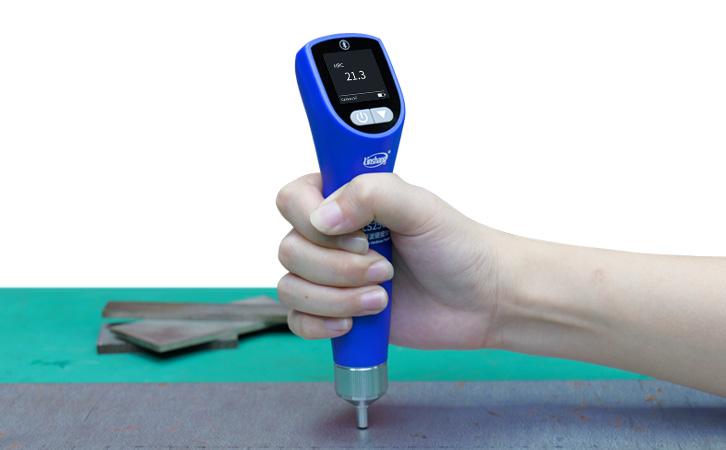
Hardness Scales HV、HRC、HRB、HRA、HS、HL、HB
Measurement Range HV(50-1700), HL(170-960), HRC(20-70), HRB(13-100),
HRA(60-85.8), HS(26.4-99.5), HB(30-651), HRE(20-70), HRF(60-100)
Resolution 1HV, 0.1HRC
Accuracy ±4%H+10HV,±2.5HRC (Probe fixture stand test, H as the standard value)
Repeatability 3%H+8HV,2HRC (Probe fixture stand test, H as the standard value)
Test Force 20N
Display 240 * 240 dot matrix IPS
Power Supply Rechargeable lithium battery 3.7V@1000mAh, full charge for over 5000 continuous measurements
Charging Port USB(Type-C)
Size 185*43*45 mm
Weight 245 g
Working Temperature Range -10~50℃,0~85%RH (no condensation)
Storage Temperature Range -10~60℃,0~85%RH (no condensation)
Supply Voltage DC5V
Operating Current 60mA
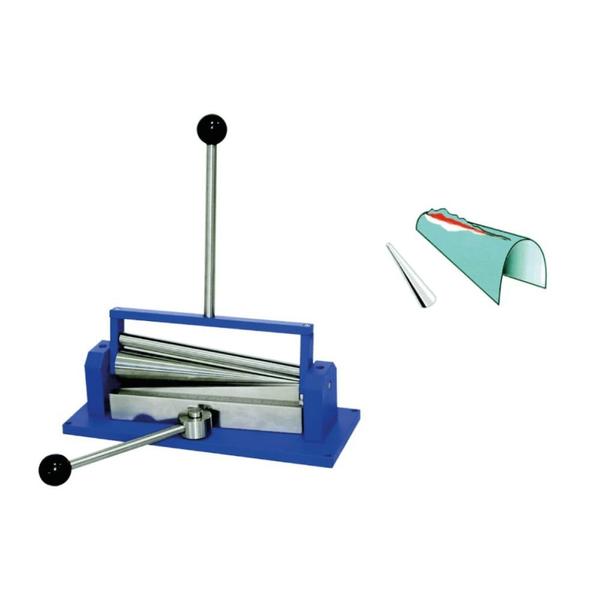
The conical mandrel bend tester is used to determine properties of a coating. Resistance to cracking
detachment from its substrate and its elongation during the test. Conical mandrel test is also known as
standard method for assessing the flexibility and the adhesion properties of coatings when these are
subjected to bending stresses This is accomplished by bending the test material around a conically
shaped metal bar. The conical mandrel bending test is a commonly used for testing for painted or
coated panels. Conical Mandrel Bend Tester is widely recommended to test the resistance of a paint, coating, varnish
to evaluate cracking or detachment from a metal panel. It is suitable for use with metal panels up to
0.8mm thick (flexible substrates up to 5mm thickness) e.g. polythenes or synthetic rubber. The
apparatus consists of a steel mandrel 203mm in length and tapering from 38mm to 3mm in diameter. It will accommodate test panels up to 19cm x 11cm in size. A graduated scale on the clamping bar
indicates the mandrel diameter at which failure has occurred. When this diameter is added to the
thickness of the panel used, the percentage elongation can be calculated. Conical mandrel detects
common failures of coating shows cracking or flaking after bending. Can be used in accordance with
DIN ISO EN 6860, ASTM D522, BS 3900 E11, DIN 53150
Conical Mandrel Bend Tester
Dimesions: 250 x 150 x 419mm
Specimen Thickness 0.80mm / 1/32“ Max specimen width 190mm
Conical mandrel: 1/8 - 1 ½“ (3.2 – 38.1 mm)
Technical specifications
Material : MS ; Cone: MS (chromium-plated steel)
Dimensions (LxHxW): 324 mm x 140 mm x 10 mm
Cone: length 203 mm, greatest Ø 38 mm, smallest Ø 3,1 mm
Test panel:
Length: 200 mm at maximum
Width: 130 mm at maximum
Thickness: max 1 mm at steel, max 2 mm at
aluminium, max 4 mm at materials with less
bending stress than aluminium
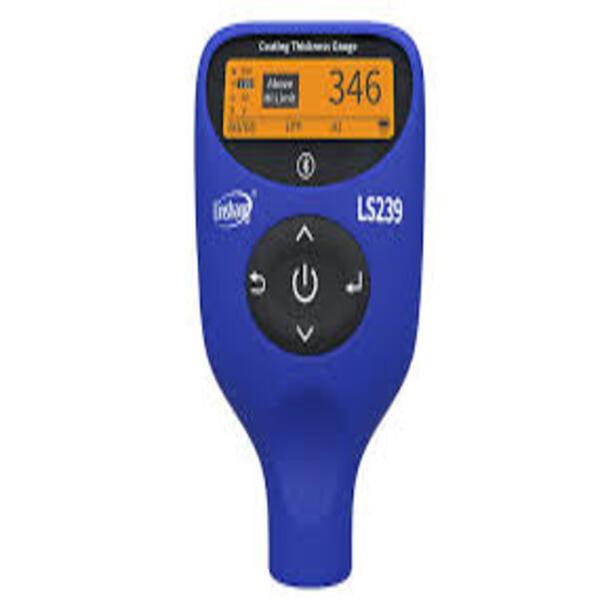
The LS239 Automotive Paint Meter is an advanced car paint/coating thickness gauge used to measure the thickness of paint and coatings on vehicle body panels. It’s ideal for:
Used car inspections (detect repainting or previous repairs)
Body shop quality control
Dealership vehicle assessments
Car enthusiast or inspector use
It works on both ferrous (steel) and non-ferrous (aluminium) substrates and can identify metallic putty/filler and galvanized layers, giving you insight into vehicle condition beyond what the eye can see.
🔥 Key Features
📊 Dual Modes: Simple & Expert
Simple Mode: Quick, go-to paint measurements.
Expert Mode: Designed for professional inspectors — lets you test 19 car components and store up to 999 vehicle records, with up to 6 measurements per component.
📱 Smart Bluetooth & Reporting
Built-in Bluetooth lets you connect to a mobile app or WeChat mini-program to record measurements, generate inspection reports, and share them easily on your phone.
🟡 Three-Color Backlight Feedback
The backlight changes color based on measured thickness:
White: Normal range
Yellow: Slightly high/low range
Red: Severe deviation, outside limits, or ferrous putty detected
This makes results easy to interpret at a glance.
⏱️ Fast & Accurate
Quick measurement: ~0.3 s per reading.
Automatic substrate recognition: Detects steel, aluminium, galvanized iron, and non-metallic body parts.
Custom alarm values can be set to trigger when measurements exceed thresholds you define.
💾 Large On-Device Storage
In Simple Mode, stores ~60 readings; in Expert Mode, can store up to 999 vehicle datasets, giving ample room for professional workflows.
🪶 Durable Probe
The ruby probe tip is wear-resistant and ensures long-term accuracy.
Advanced digital probe technology processes measurements directly at the probe, reducing interference and improving stability.
📐 Continuous Measurement & Rotatable Display
Continuous mode: Hold the probe and slide for sliding/continuous readings — showing max/min values in simple mode.
Rotatable screen: In Simple Mode, the display rotation can be switched for easier viewing in tight spaces.
📊 Technical Specifications
Feature Specification
Probe tip Ruby (wear-resistant)
Measuring principle Fe: Hall effect / Al: Eddy current
Probe type Integrated
Measuring range 0.0 – 5000 µm
Resolution 0.1 µm / 1 µm / 10 µm
Accuracy ≤±(3 %H + 2 µm) (0–3000 µm)
≤±(5 %H + 2 µm) (3000–5000 µm)
Display 192×64 dot-matrix LCD
Measuring interval ~0.5 s
Min. measuring area Ø 25 mm
Min. curvature Convex: 5 mm / Concave: 25 mm
Min. substrate thickness Fe: 0.2 mm / Al: 0.05 mm
Battery Rechargeable lithium 3.7 V @ 1200 mAh
Operating temp. −20 °C – 50 °C
Storage temp. −20 °C – 60 °C
Weight ~88.8 g
Dimensions 108 × 70 × 31 mm
Connectivity Bluetooth
🧠 Typical Uses
Used Car Buyers & Inspectors:
Compare paint thickness across panels to spot inconsistencies.
Detect putty or filler indicating previous body repairs.
Body Shops & Detailers:
Validate even application of paint and coatings.
Record and document thickness readings for quality assurance.
Dealers & Auctions:
Produce professional reports for vehicle condition transparency.
📦 What’s Included
LS239 Paint Thickness Gauge
Fe & Al zero adjustment plates
Standard test film
USB rechargeable cable
User manual & warranty card (contents may vary by seller)
📌 Summary
The Linshang LS239 Automotive Paint Meter is a feature-rich, fast, and accurate car paint thickness gauge with simple and expert modes, Bluetooth reporting, large storage capacity, and smart substrate/putty detection — making it well-suited for professional inspectors, used car evaluators, and body shop quality control workflows
Automotive Paint Meter
product-detail-entry-exit
HPFS Instruments India LLP 302, Sohan Commercial Plaza, Navghar, Nr. Vasai Railway Station, Vasai East, Vasai - 401209, Thane, Maharashtra, India

 Chat with us
 Chat with us