
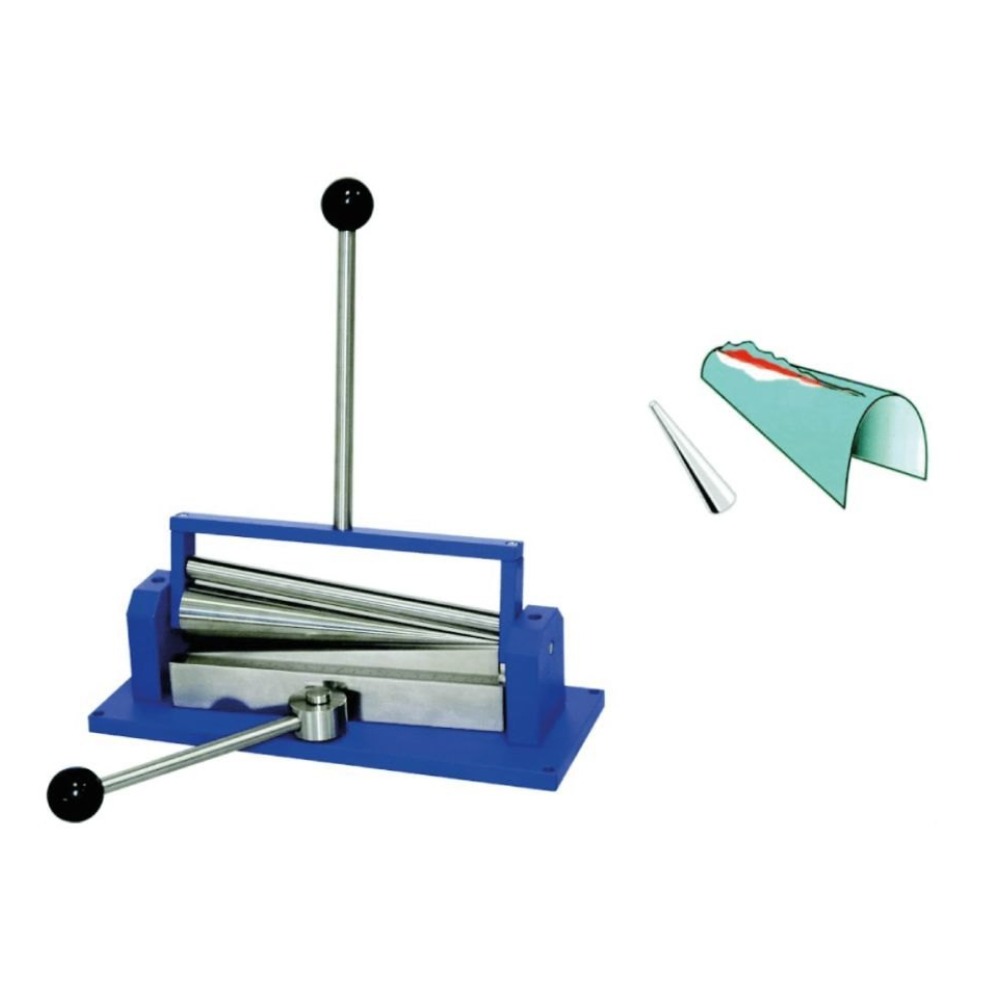
The conical mandrel bend tester is used to determine properties of a coating. Resistance to cracking
detachment from its substrate and its elongation during the test. Conical mandrel test is also known as
standard method for assessing the flexibility and the adhesion properties of coatings when these are
subjected to bending stresses This is accomplished by bending the test material around a conically
shaped metal bar. The conical mandrel bending test is a commonly used for testing for painted or
coated panels. Conical Mandrel Bend Tester is widely recommended to test the resistance of a paint, coating, varnish
to evaluate cracking or detachment from a metal panel. It is suitable for use with metal panels up to
0.8mm thick (flexible substrates up to 5mm thickness) e.g. polythenes or synthetic rubber. The
apparatus consists of a steel mandrel 203mm in length and tapering from 38mm to 3mm in diameter. It will accommodate test panels up to 19cm x 11cm in size. A graduated scale on the clamping bar
indicates the mandrel diameter at which failure has occurred. When this diameter is added to the
thickness of the panel used, the percentage elongation can be calculated. Conical mandrel detects
common failures of coating shows cracking or flaking after bending. Can be used in accordance with
DIN ISO EN 6860, ASTM D522, BS 3900 E11, DIN 53150
Conical Mandrel Bend Tester
Dimesions: 250 x 150 x 419mm
Specimen Thickness 0.80mm / 1/32“ Max specimen width 190mm
Conical mandrel: 1/8 - 1 ½“ (3.2 – 38.1 mm)
Technical specifications
Material : MS ; Cone: MS (chromium-plated steel)
Dimensions (LxHxW): 324 mm x 140 mm x 10 mm
Cone: length 203 mm, greatest Ø 38 mm, smallest Ø 3,1 mm
Test panel:
Length: 200 mm at maximum
Width: 130 mm at maximum
Thickness: max 1 mm at steel, max 2 mm at
aluminium, max 4 mm at materials with less
bending stress than aluminium